The Compass That Cannot Lie: Where This Actually Started
Around two thousand years ago, during China's Han Dynasty, someone carved a spoon out of lodestone, magnetised rock, and set it spinning on a bronze plate. It was called the sinan, the "south-governor." Nobody used it to navigate anything. It was a fortune-telling tool: geomancers used it to align buildings, choose burial sites, and read the land according to feng shui. For the better part of a thousand years, that's all it was ever trusted to do.
Then, sometime around the 11th century, during the Song Dynasty, someone did something braver with it. Ship pilots started carrying it out to sea. The old method was simple enough in daylight: steer by the sun, steer by the coastline you could still see. But in genuinely dark weather, with no stars and no land in sight, historical accounts describe those pilots doing something that must have felt close to reckless the first time anyone tried it. They looked down at a needle they couldn't fully explain, and they trusted it with their lives, over the open ocean, with nothing else to go on.
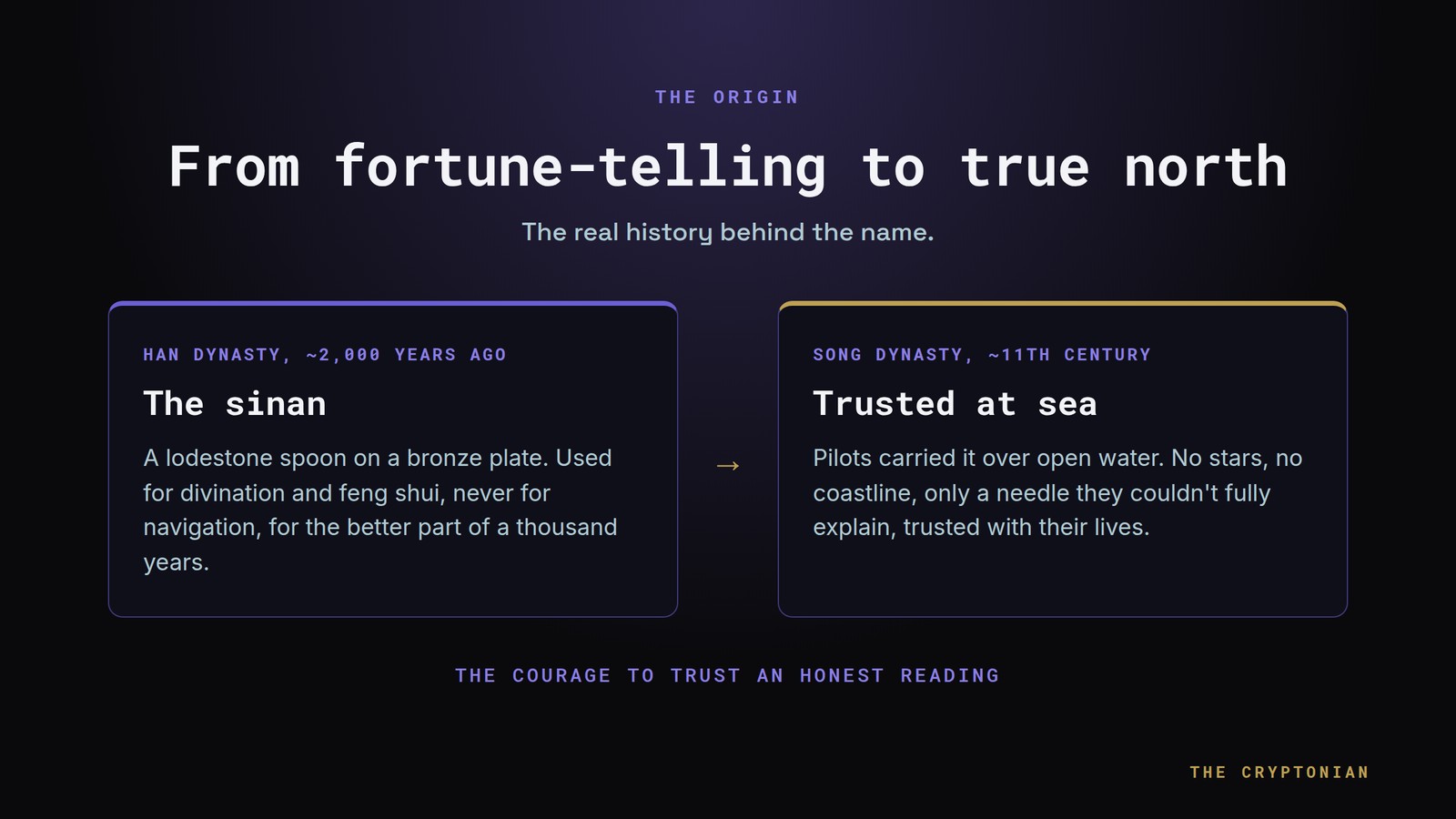
That's the actual story behind the name of the framework everything on this blog is built on top of. Not a metaphor I bolted on afterward. The real history of the tool.
A compass cannot lie to you
Here's why that story matters more than a bit of trivia. A compass doesn't respond to your mood. It doesn't care what you'd prefer to believe about which way you're facing. It responds to real input, magnetic north, an absolute reference point that exists whether you check it or not. Ask it a question and it gives you the honest answer, not the comfortable one.
That's the entire premise C.O.M.P.A.S.S. was built on, seven years before The Cryptonian existed as a name or a brand. I built it because I kept watching the same pattern play out with people I worked with directly: real intelligence, real desire, real opportunity, and somehow none of it converting into movement. The problem was never information. Everyone already has access to more information than they could use in a lifetime. The problem was a lack of something honest enough to check their actual direction against, rather than the direction they told themselves they were heading.
I gave that framework away for free. In rooms, on calls, to network marketers, business owners, entrepreneurs and athletes, over 100,000 people across seven years, long before any of it was packaged as a course or attached to a blog. No funnel behind it. No product to sell at the end of the session. Just a tool people could pick up when they needed real direction and put down when life got in the way, trusting it would still be there when they came back to it.
What C.O.M.P.A.S.S. actually stands for
Seven letters, one honest principle per letter. In the course, each letter gets its own module, with an introduction before them and a close after, nine modules in all.
Commitment. Not motivation, which is a feeling that shows up and leaves on its own schedule. Commitment is a decision you keep making after the feeling is gone.
Observation. The step almost everyone skips, and the one that matters most. You cannot correct a direction you refuse to actually look at.
Mindset. The operating system every other decision in your life runs on top of. Get this wrong and no amount of tactics fixes it.
Planning. The heaviest module in the whole course, deliberately so. This is where the direction gets turned into an actual route, not just a destination, using the ROADMAP framework for turning a vague goal into something you can act on.
Action. Where planning either becomes real or quietly dies on a page.
Sacrifice. What every real direction change actually costs, said out loud instead of glossed over.
Success. Not an ending. A checkpoint you use to recalibrate and choose the next direction.
Each module is built the same way: a video lesson, and a Companion Workbook you print and write in by hand. That's deliberate too. We call it Think in Ink. A phone screen is built to pull your attention somewhere else. A pen and a page in front of you are built to hold it exactly where it needs to be.
Why it's a cycle, not a checklist
Most frameworks are built to be finished. You work through the steps once, tick the last box, and move on. C.O.M.P.A.S.S. was never built that way, because life doesn't hand you one direction and leave it fixed forever. You'll come back to Commitment at a different life stage than the one you first read this at. Observation looks different once you've actually built something worth protecting. That's not a flaw in the framework. It's the entire point of building it around a compass instead of a map. A map shows you one route to one destination. A compass works for however many times your direction actually needs correcting.
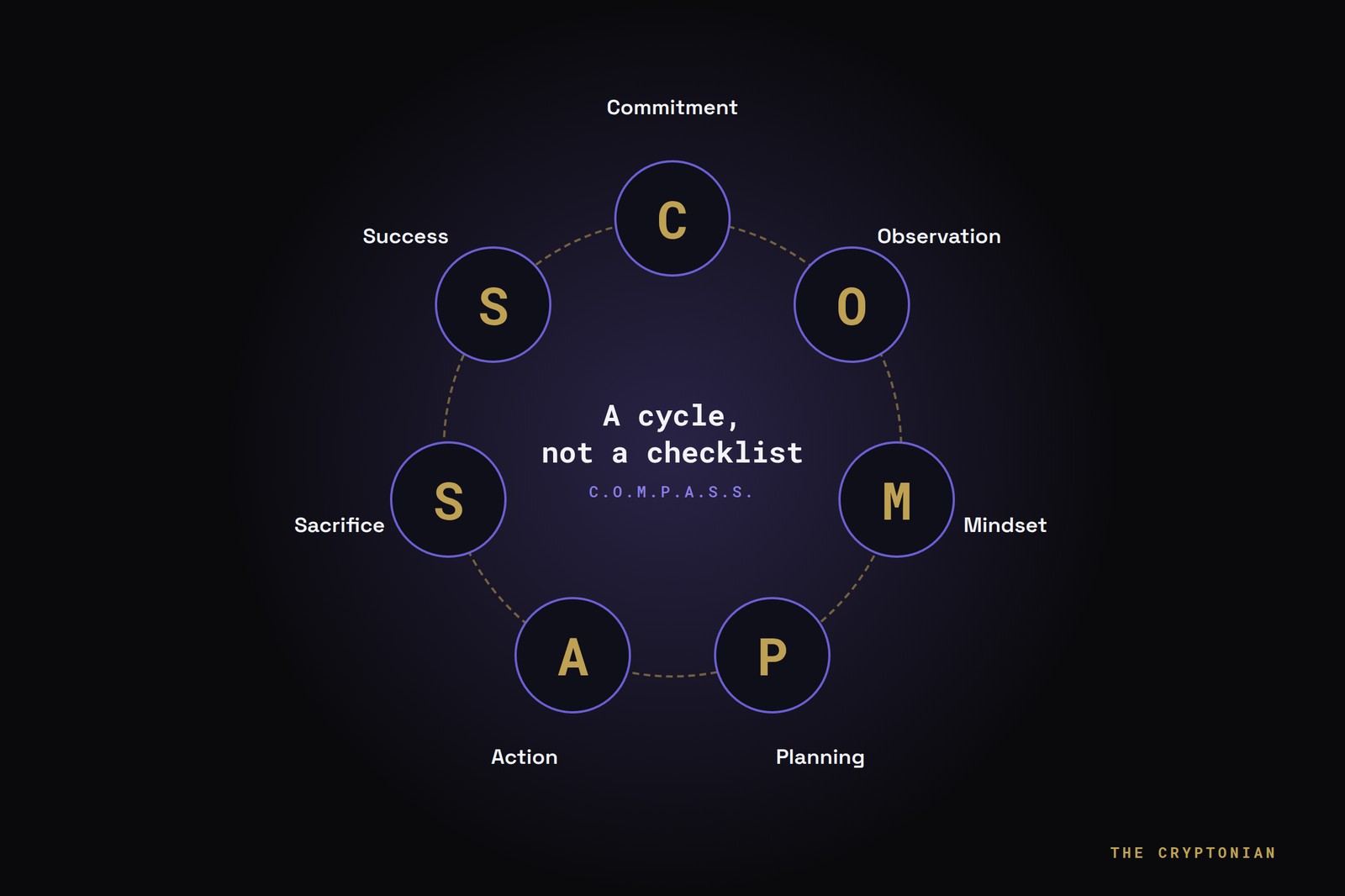
Think about what that looks like in practice. Someone works through Commitment in their twenties while building a career, and it reads as a lesson about showing up on the bad days. The same person comes back to that exact module a decade later, now responsible for a family or a team, and it reads as something closer to a test of whether their word still means anything once nobody's checking. The letter didn't change. They did, and the framework was built to meet them wherever they'd moved to, not to hand them the same answer twice and call it finished.
"A compass doesn't care what you'd prefer to believe. It only ever shows you where you're actually pointing."
THE CRYPTONIAN
Why this is the real foundation, not a footnote
Everything else covered on this blog, the financial sovereignty content, the four pillars, eventually the partner features, runs on top of this same operating system. That's not a coincidence and it's not marketing language. The Cryptonian was built using C.O.M.P.A.S.S. as its foundation, not the other way around, and that sequence matters. Money without direction just gets you lost faster. A framework that keeps your direction honest is what makes everything else actually worth building.
Where C.O.M.P.A.S.S. is now
For seven years this only existed in rooms and on calls. It's now a complete course, built properly rather than rushed out to hit a date: nine modules, each with its own video lesson and its pages in the Companion Workbook. Seven years of teaching it taught me exactly what lands and what doesn't, and all of that went into the build.
Everyone who enrols gets lifetime access, the full Companion Workbook, and a place in The Compass Room, the private community where members work through the letters together. It's the same framework 100,000 people trusted for free, now in a form you can work through at your own pace and come back to at every new stage of your life, which is exactly what a cycle is for.
If you want to see exactly what's inside, the full breakdown is on the C.O.M.P.A.S.S. course page.
Where to go next
If this is the first you're hearing about C.O.M.P.A.S.S., the first edition of this blog covers how it connects to everything else here. This edition was the real story behind the name. The next one goes back to the financial side, starting with the sovereignty quality most people miss: the freedom to go anywhere.
THE CRYPTONIAN
The Cryptonian provides information only. Not financial, tax or legal advice. All opportunities involve risk.