The Four Qualities Nobody Tells You About Financial Freedom
Ask most people what financial freedom looks like and they'll describe a number. A figure in a bank account. A point at which they no longer have to work. A retirement date circled on a calendar.
That framing is understandable. It's how we've all been taught to think about money: earn enough of it and you're free. But it misses something fundamental. Numbers held inside institutions can be eroded, frozen, taxed away, or simply lost. A number alone is not sovereignty. What actually matters is the architecture sitting underneath that number, and almost nobody ever gets shown what that architecture is supposed to look like.
Last edition, we covered why the traditional system tends to work against you by default: the 1971 break from gold, structural inflation, and what happens when custody of your money sits with someone other than you. If you haven't read that one yet, it's worth going back to first; this post picks up exactly where it left off.
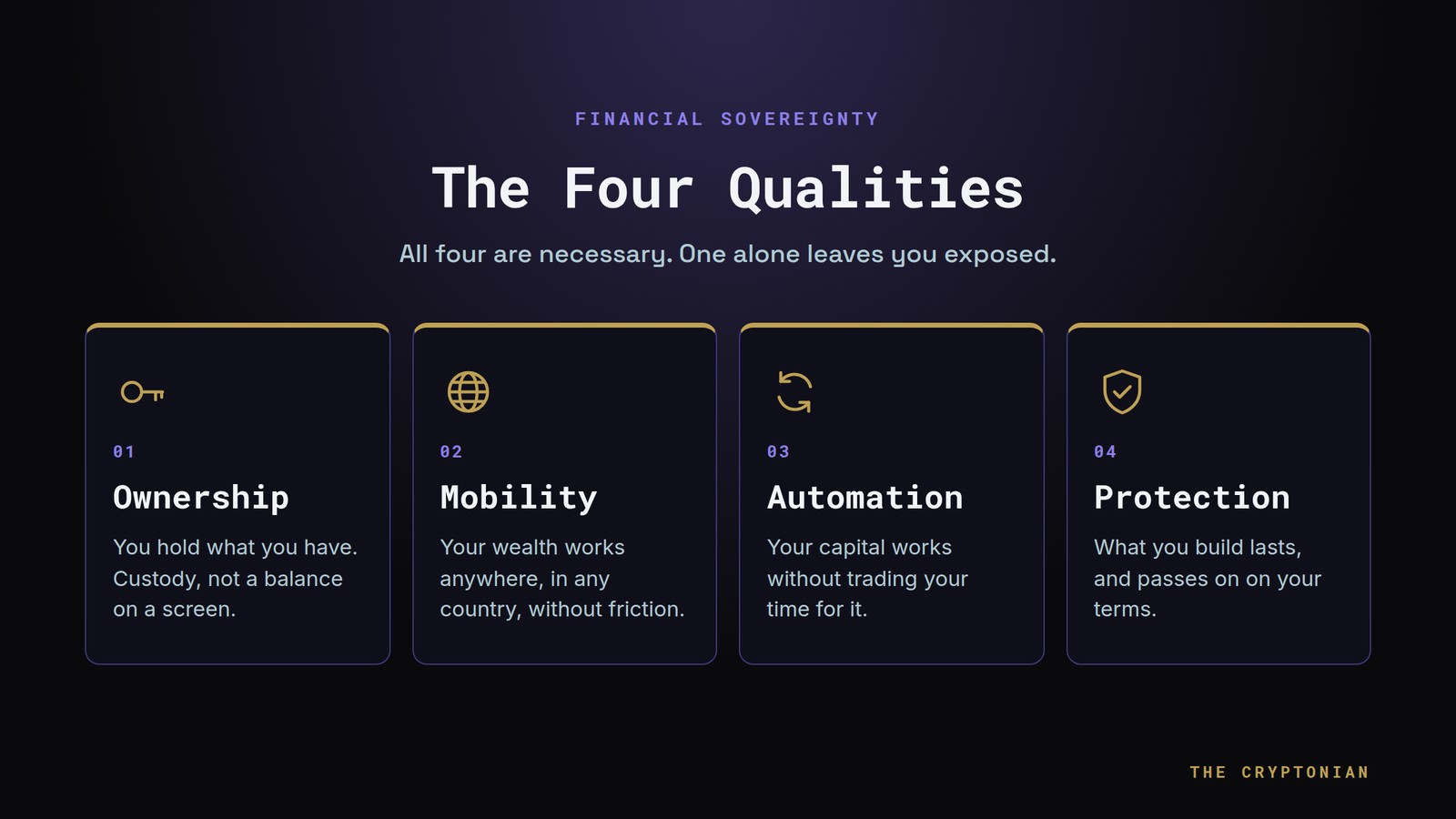
Financial sovereignty has four distinct qualities, and all four are necessary. One without the others leaves you exposed in ways you might not notice until it's too late.
Ownership: you hold what you have
The first quality is genuine ownership. Not the appearance of ownership (a balance on a screen) but actual custody: the ability to access, move and control what's yours without needing permission from any institution.
For most people, most of their wealth sits in forms they don't truly own. Bank deposits are institutional liabilities. Pension funds are managed by third parties under rules that can change. Even brokerage accounts exist within frameworks that can impose restrictions during periods of stress.
Not your keys, not your coins. That principle extends far beyond cryptocurrency. True ownership means holding assets in a form where you, and only you, control access. It's the foundation everything else in this framework is built on top of, which is exactly why it's the first pillar we teach, not the last.
This isn't hypothetical either. In January 2021, during a period of extreme volatility in a handful of heavily shorted stocks, several major brokerages restricted customers from buying more shares, even though those customers had cash sitting in their accounts ready to spend. The platforms were within their rights to do it. That's exactly the point: the rules of the account were never fully yours to begin with. An asset you can be stopped from buying, selling, or moving on someone else's schedule was never entirely under your control in the first place.
Mobility: your wealth works anywhere
The second quality is mobility, and it's the one people underestimate the most until their life actually requires it. A sovereign financial life isn't tethered to a single geography, currency, or institution. Your wealth should be accessible from anywhere in the world, spendable in any country, transferable without friction.
This is where sovereignty stops being an abstract financial idea and starts describing an actual way of living. Anyone who's tried opening a local bank account as a newcomer, wiring money internationally through correspondent banks, or had a card decline abroad for no clear reason already understands the problem intuitively: traditional banking assumes you stay in one place, bank with one institution, and transact in one currency. The moment your life crosses a border, for work, for family, for retirement, for simply wanting to live somewhere else for a season, that assumption starts working against you.
This matters enough to us that it gets its own dedicated edition shortly: a life that can't move as freely as the person who built it is a life still tethered to the very institutions it was meant to be free of. Building something they can't touch means building something that isn't geographically anchored to begin with, and we'll go much deeper into exactly what that looks like in practice, including how travel and mobility fit directly into this framework, very soon.
Automation: your capital works without you
The third quality is automation: the ability to generate returns from your capital without the constant exchange of your own time. Automated strategies, AI-driven systems, and signal-based approaches to markets now exist at a level of sophistication that used to be available only to institutional investors.
Your capital should be working while you sleep. If it isn't, you're still trading time for money, just at one remove.
Automation doesn't mean abdication. It means deploying capital into systems you understand, have researched, and have chosen deliberately, then allowing those systems to operate without requiring your daily involvement. Time is the one resource that never comes back once spent. Capital that works without your constant attention compounds your actual free time, not just your net worth, which is the entire point.
Protection: what you build lasts
The fourth quality is protection: legal, structural, and intentional. Building wealth is one challenge. Protecting it from taxation, litigation, institutional failure, and generational erosion is another, and it's one most people never address until it's already too late.
The right legal structure, an offshore company, a properly constituted trust, or a combination of both, can legitimately reduce tax exposure, separate personal assets from business liabilities, and ensure that what you build is preserved across time and transferred on your own terms rather than left to whatever happens by default.
To be clear about what this isn't: financial sovereignty is not tax evasion, regulatory avoidance, or living off the grid. Every tool referenced across this framework is legal, documented, and used by millions of people globally. It's simply the deliberate, informed use of structures the financial system already makes available, that most people never discover because no one ever shows them they exist.
Without any structure in place, what happens by default is rarely what you'd have chosen deliberately. Assets can sit tied up in probate for months or years. Inheritance can be split according to a jurisdiction's default rules rather than your actual wishes. None of that requires anything to go wrong. It's simply what happens when no one ever builds the alternative, because no one ever showed them it existed.
Why all four, together
When all four qualities are present (ownership, mobility, automation and protection) you've built something that can't easily be disrupted. That's the life this whole framework is designed to build. Not one day. Now, one layer at a time.
"A number alone is not sovereignty. What matters is the architecture sitting underneath it."
THE CRYPTONIAN
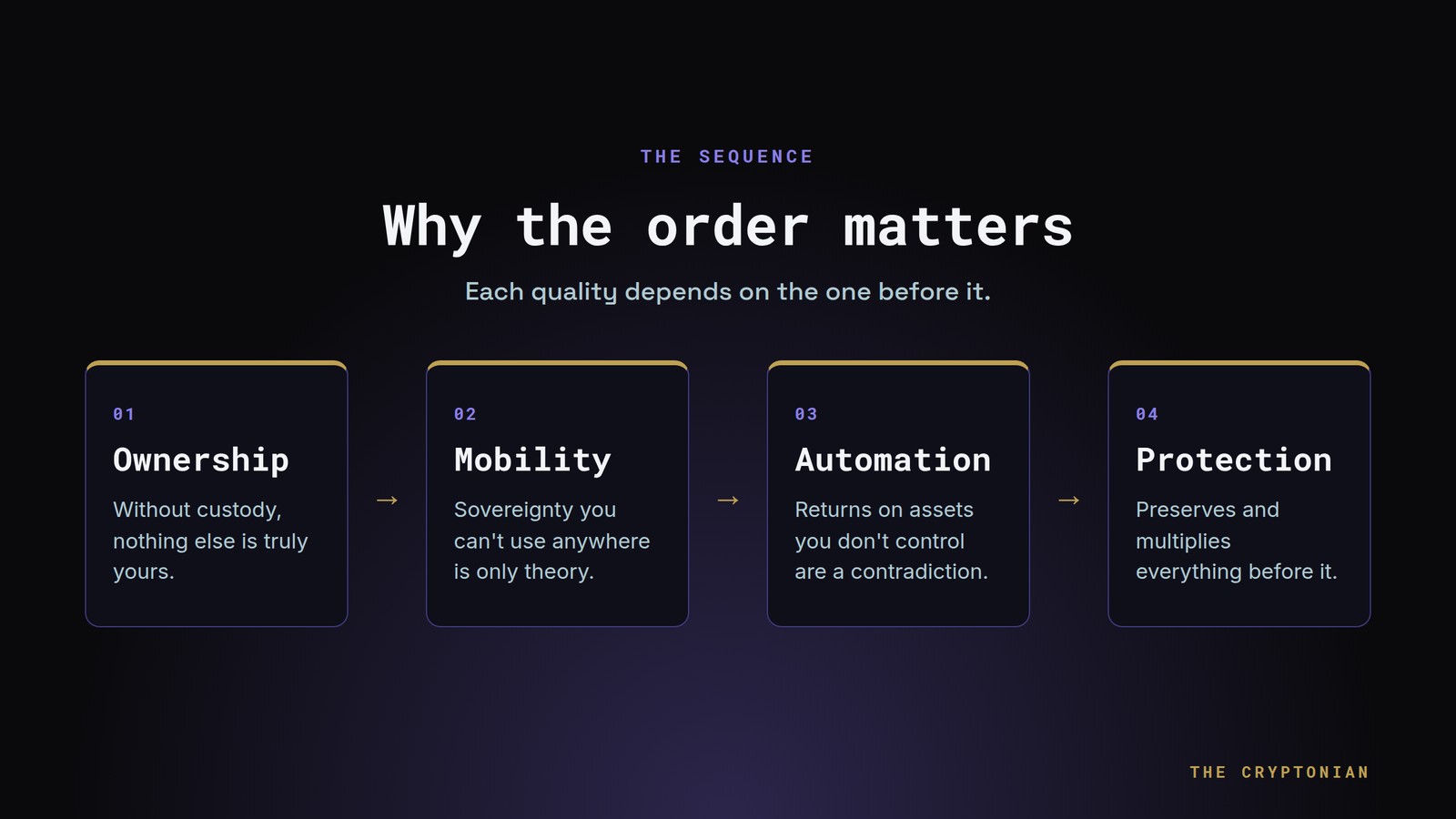
It's worth being honest about the order, too, because it isn't arbitrary. Ownership comes first because without custody, nothing else is truly yours. Mobility comes second because sovereignty without the ability to actually use your wealth anywhere is only theoretical. Automation comes third because generating returns from assets you don't properly control is a contradiction. Protection comes fourth because it's what preserves and multiplies everything that came before it. We'll walk through this exact sequence, and how to actually start building it, as its own dedicated edition soon.
Where to go next
This post has deliberately stayed at the level of principle. The next edition goes back to where this whole framework actually started, and it has nothing to do with markets.
THE CRYPTONIAN
The Cryptonian provides information only. Not financial, tax or legal advice. All opportunities involve risk.