Why the Traditional Financial System Works Against You
If you've done everything you were told to do (worked hard, saved consistently, avoided obvious risk) and still feel like the ground keeps shifting under you, I want to say something plainly before we go any further: it isn't you.
That feeling isn't a personal failure of discipline or planning. It's the accurate perception of a system that was never actually built to protect what you hold. Most people never get told this directly, so they spend years quietly blaming themselves for a problem that was designed in, not one they created. Every payday that buys a little less than the last one. Every "temporary" bank restriction that never quite goes back to normal. Every retirement projection that assumes the next forty years behave like the last forty, when nothing about the current system was actually built to guarantee that. This edition is the honest version of that history: not to make anyone angry, but because you can't build a genuine alternative to something you don't understand yet.
The day the promise changed
In 1971, the United States severed the last formal link between the dollar and gold. Under the Bretton Woods system built after the Second World War, the dollar had been convertible to gold at a fixed rate, and every other major currency was pegged, in turn, to the dollar. It was meant to bring stability to a world rebuilding itself.
By 1971, foreign governments held more dollars than the United States held gold to redeem them. Rather than let that imbalance play out, the link was simply suspended. What was announced as a temporary measure was never restored. What followed was the birth of a fully fiat monetary system: currency backed not by a tangible asset, but by institutional trust and government decree. Every major economy followed. The world has been operating on this model ever since.
That single decision, made over a weekend, is the root of almost everything covered in this post. It's easy to treat 1971 as a dry footnote in economic history. It isn't. It's the year the value of your money stopped being anchored to anything except confidence in the system printing it.
Inflation isn't a bug. It's a structural feature
The consequences compound quietly. When governments need money they don't have, they create it. When central banks want to stimulate an economy, they lower rates and expand the supply. The result is a system with a structural, near-permanent tendency toward inflation: a slow, consistent erosion of purchasing power that touches every unit of currency sitting in a savings account.
You are not imagining it. The cost of everything rises. The value of what you saved falls. This is not an accident. It is a mechanism of control.
That's not a conspiracy theory. It's simply how the architecture was built, and understanding it is the first step to building something that doesn't depend on it. The person who saved diligently for a decade and still feels behind isn't bad at money. They're playing a game where the value of the chips quietly shrinks every year, by design, and nobody tells you that going in.
The deposit you don't actually own
Alongside inflation sits the banking system itself, and it's worth understanding exactly how it works rather than simply distrusting it on instinct. Banks operate on a fractional reserve model: they're required to hold only a fraction of deposits on hand, and are free to lend, invest, and deploy the rest. Money deposited in a bank isn't yours in the way most people assume. It's a loan to the institution. The bank uses it, lends it, invests it. You receive a fraction of a percent in return.
Deposit protection schemes exist in most countries, but they're capped. Above that threshold, in the event of failure, you're simply an unsecured creditor standing in line with everyone else, behind bondholders and other institutional claims.
And access itself is conditional, not guaranteed. If a bank runs into difficulty, your access can be restricted. If a government declares a financial emergency, as has happened in Cyprus, Greece, Lebanon and elsewhere, accounts can be frozen, withdrawals capped, capital controls imposed overnight. Cyprus in 2013 is the clearest modern example: as part of an international bailout, a portion of deposits above the insured threshold was directly seized and converted into bank equity, essentially overnight, for anyone who believed their savings were simply theirs to hold. Lebanon's banking crisis from 2019 onward tells a quieter, slower version of the same story: informal capital controls that were never formally legislated, leaving ordinary depositors locked out of their own accounts for years, with no clear end date given.
None of this requires malice on anyone's part. It's simply how the architecture functions. The system was built to keep capital in institutional hands, moving through institutional channels, generating institutional returns. You are, at best, a secondary beneficiary of that arrangement, and only for as long as conditions stay calm enough for the arrangement to hold.
Where Bitcoin enters the picture
This is the context Bitcoin was actually created in. It wasn't built in a vacuum, and it wasn't built by people looking to get rich quickly. It was created in 2009, in direct response to the 2008 financial crisis, when the world watched institutions considered "too big to fail" get bailed out with public money while ordinary depositors absorbed the consequences. Its founding document described a peer-to-peer electronic cash system that required no trusted third party: no bank, no central authority, nothing capable of freezing, inflating, or confiscating your holdings on your behalf.
We'll go much deeper into what's actually been built on top of that idea, including the practical, dollar-stable tools that make it usable day to day, in a dedicated future edition. For now, the point is simply this: an alternative to institutional dependency isn't theoretical anymore. It already exists, and it's been tested in public for over fifteen years.
It isn't just banks
Here's the part that catches people who think the answer is as simple as "move everything into crypto and the problem disappears": the exact same failure pattern shows up inside the crypto industry too, whenever custody is handed to a third party instead of held directly.
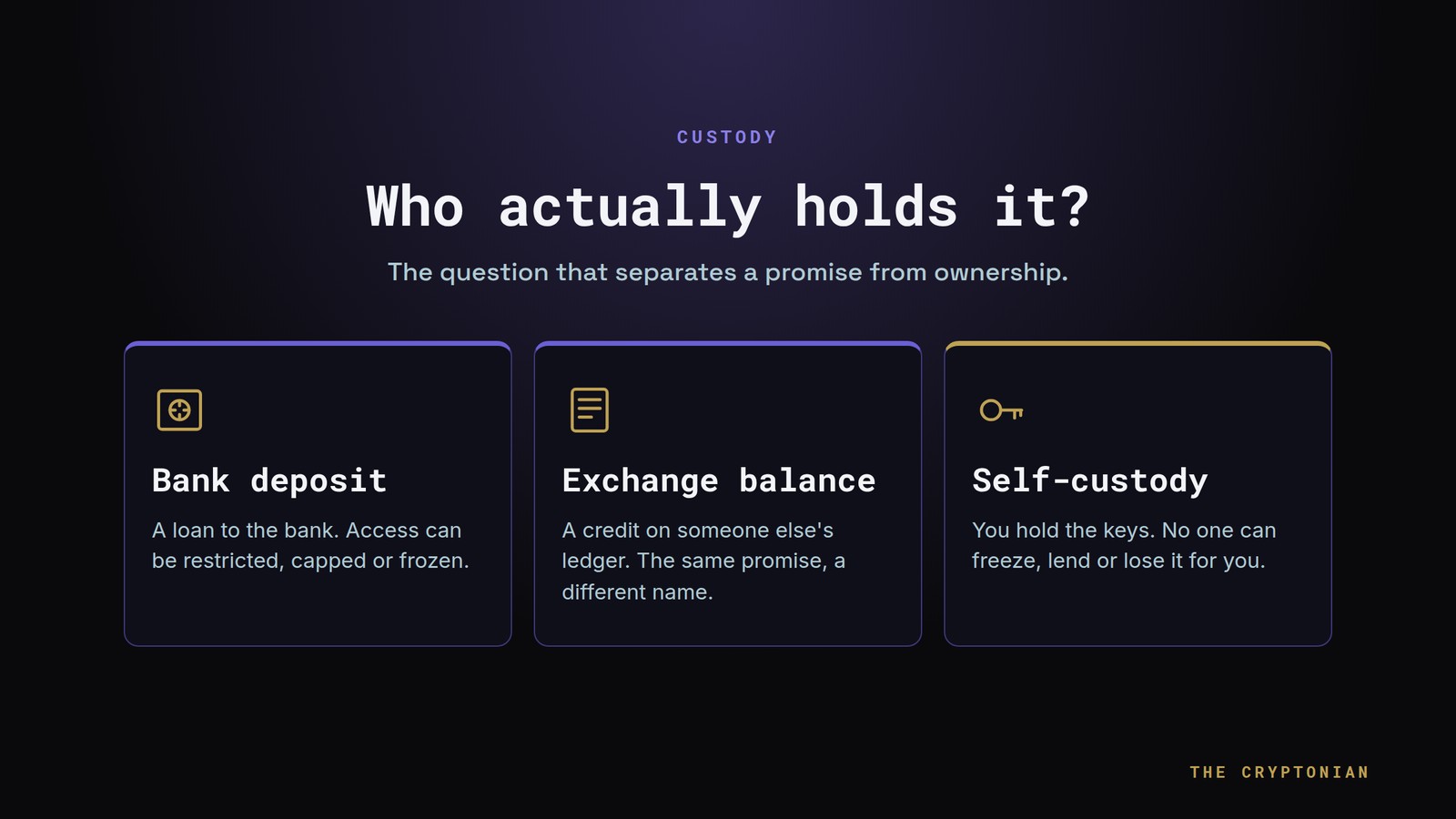
Most people who own cryptocurrency don't actually hold it in self-custody. They hold it on an exchange. When you buy Bitcoin, Ethereum, or any other asset on a centralised exchange, what you receive isn't the asset itself. It's a credit on that platform's internal ledger. The exchange holds the actual cryptocurrency. You hold a promise, exactly the same shape of promise a bank deposit is.
The risks of that arrangement have been demonstrated repeatedly, and catastrophically. Mt. Gox wiped out 850,000 Bitcoin in 2014. Celsius froze withdrawals in June 2022 before filing for bankruptcy. FTX, once the second largest crypto exchange in the world, collapsed in November 2022, taking billions in customer funds down with it. And in February 2025, Bybit, one of the world's largest exchanges, was hacked for an estimated $1.4 to $1.5 billion: the single largest theft in crypto history. Bybit survived. It remains operational today, still ranked among the largest exchanges globally by trading volume.
But survival isn't the same as safety. The lesson here isn't that every exchange will eventually collapse. It's that even the ones that don't are still not where self-custody belongs. A credit on someone else's ledger is a credit on someone else's ledger, whether the institution wears a bank's name or an exchange's, and whether it fails outright or simply survives a billion-dollar breach.
"A credit on someone else's ledger is a credit on someone else's ledger, whether the institution wears a bank's name or an exchange's."
THE CRYPTONIAN
The pattern, not the individual failures
Zoom out far enough and Cyprus, Lebanon, Mt. Gox, Celsius, FTX and Bybit stop looking like six unrelated news stories. They're the same underlying pattern, wearing six different names: capital handed to a third party, on the promise that the third party will always be able and willing to give it back on demand. Sometimes that promise holds for decades. Sometimes it breaks overnight, with no real warning given to the people who trusted it.
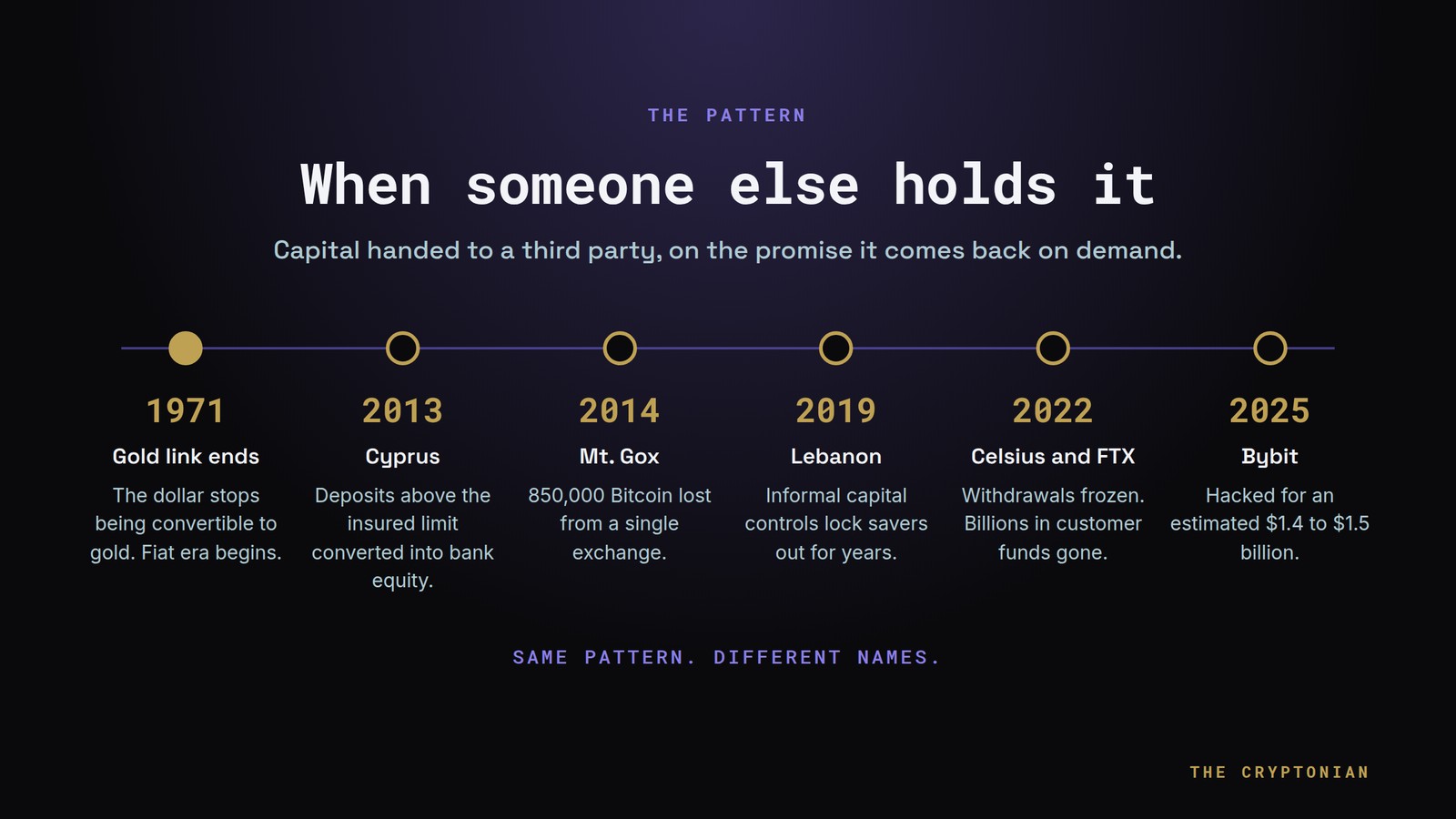
That pattern is the actual thing this edition is asking you to see. Not any single institution as the villain. The architecture itself, and the fact that almost nobody is ever shown there's a different way to build.
What this actually means
This isn't a call to panic, and it isn't a call to abandon the traditional system entirely. It's an invitation to see it clearly for what it is: infrastructure built decades ago, for a different set of priorities than yours, that most people were never given the tools to look past.
Once you can see the architecture, the question changes. It stops being "how do I get more money inside this system" and starts being "what would a financial life look like if it didn't depend so heavily on institutions that can freeze, restrict, or erode what I hold." That's not a theoretical question. There's a genuine answer to it, built from tools that already exist and are used by millions of people globally, entirely within the law.
That answer is what we call the Freedom Stack: four pillars, built in sequence, that together create a financial life that's far harder to disrupt, freeze, erode, or take from you. We'll walk through what that actually looks like, stripped of jargon, in the next edition of this blog.
Where to go next
If you want the complete picture in one sitting rather than waiting for the next post, the free Freedom Stack eBook, Build The Life They Can't Touch, covers this exact history in more depth and then walks straight into the four-pillar sequence built in response to it. It's the natural next step from everything in this post.
Further reading: the Bybit hack referenced above is covered in detail by Forbes and CSIS. The Cyprus, Lebanon, FTX, Celsius and Mt. Gox events are all extensively documented public record, and are covered in more depth, with full context, in Chapter 01 of the Freedom Stack eBook.
THE CRYPTONIAN
The Cryptonian provides information only. Not financial, tax or legal advice. All opportunities involve risk.